← Gallery · Roll 02 / 06 · Business account and spend cards
Purser
A founder who wants the team to spend freely without losing track hands out cards with the rules printed into them, and finds the month closes itself.
Screening
The live production, running below. Scroll inside it.
The treatment (treatment.md)
Written by the agent during production, unedited.
Open the full treatment
Fictional demo. Purser is an invented business account with corporate spend cards for startups. Bank, rates, fees and regulatory wording are illustrative and labelled so on the page.
1. Development
Product truth. A US business account plus physical and virtual cards. Each card carries its own rules (role → allowed merchants, monthly limit, approval steps). Payments appear live, receipts are collected by text reply, any card freezes instantly, month end is an export. Audience. Founders and finance leads of 5–50 person startups, solution-aware (they know the category from the incumbents), comparing on control, fees and safety. Primary action: Open an account. Secondary: Talk to sales (50+ cards, migrations).
Logline. A founder who wants the team to spend freely without losing track hands out cards with the rules printed into them, and finds the month closes itself.
Audience arc. Arrive: "cards for the team means a mess of receipts and one scary statement." Leave: "each card carries its own limit and approvals, I can stop one in a second, and the money sits at a bank."
2. Casting session
Dramatic problem: lending control without losing it — trust in the team plus a grip the founder can feel.
| Candidate | Mechanism that solves it | Signature shot | Risk / wrong for |
|---|---|---|---|
| Billy Wilder — The Apartment (1960), Joseph LaShelle (camera), Alexandre Trauner (design) | Opens on statistics told by one clerk, then finds him in a forced-perspective office of identical desks; a key lent to others on a schedule; ends on a hand of cards being dealt | A floor of identical units receding to a vanishing point under a ceiling of light panels, one of them singled out | Risk: grey office reads dull if the light is flat. Wrong for: anything that needs night or spectacle |
| Jim Jarmusch — Night on Earth (1991) | Five taxi rides in five cities at the same instant, joined by clock title cards and a running meter: spend happening everywhere at once | Five city clocks over black, one meter ticking | Clocks as instruments repeat the last two productions (live clock, skin clock); night palette repeats the ER demo; the turn is not about control |
| Alfred Hitchcock — Rear Window (1954) | One fixed seat that sees every window, each a small story: the dashboard that sees every card | The blind rising on the courtyard | Reads as watching employees. Wrong for a product whose promise is trust in the team |
Cast: Wilder, The Apartment. Set aside Jarmusch (instrument and palette repetition, wrong turn) and Hitchcock (surveillance reading kills trust). Competitor test: a competitor could not use this unchanged, because it is built on the card as a dealt, lent object with its rules on its face, and ends on the deal. A generic "dashboard" fintech has no deal.
Mechanisms (each visible):
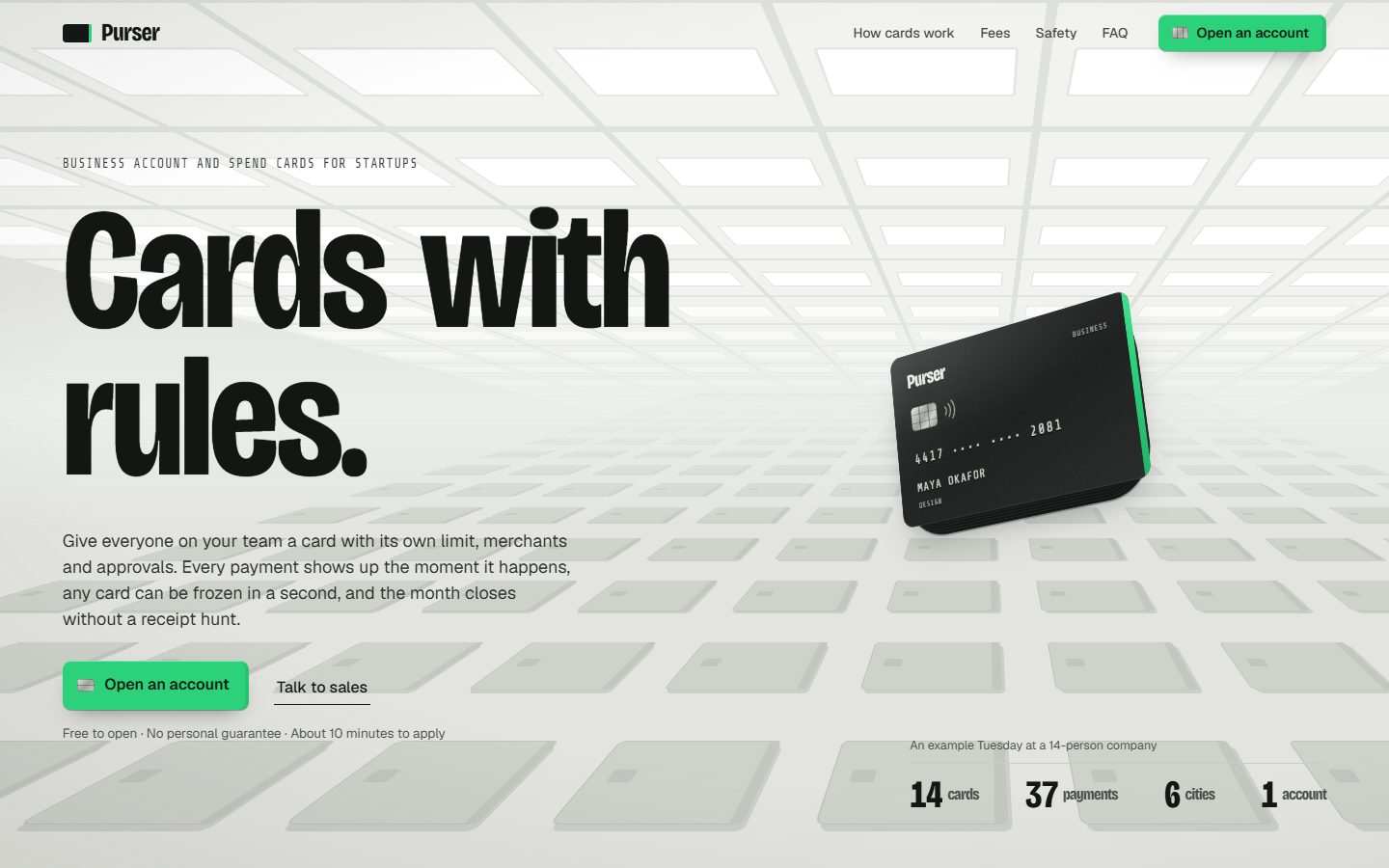
- Statistics first, then one face in the crowd → the hero opens on an example Tuesday counted out (odometers: 14 cards · 37 payments · 6 cities · 1 account), then the camera finds one card. Hero.
- Trauner's forced-perspective floor → a CSS-3D floor of identical grey cards receding to a vanishing point under a ceiling of light panels; the lead card stands up out of it. Hero.
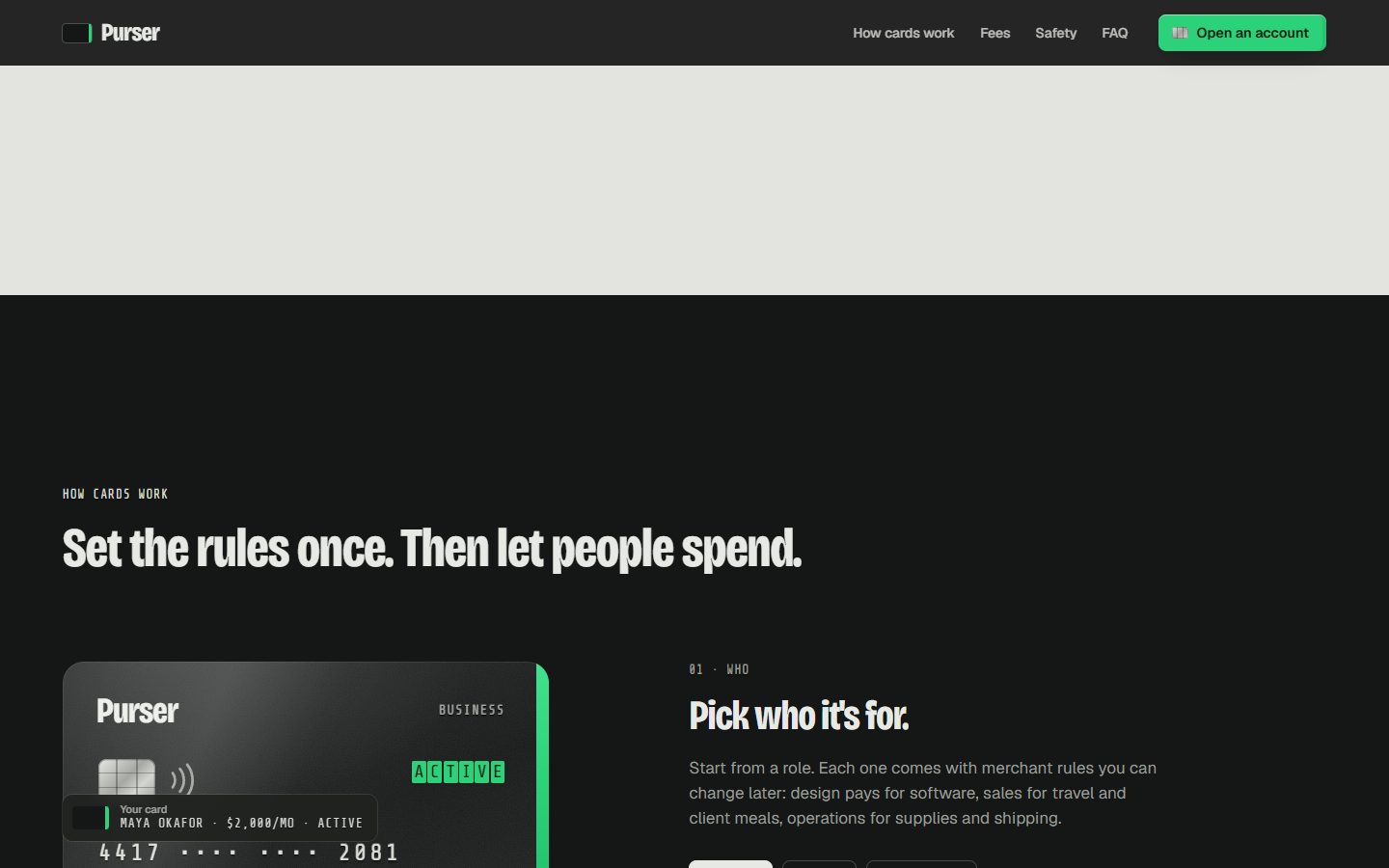
- The key lent on terms (the schedule of who gets it when) → each card is lent on terms you set by hand: role, limit, approvals, printed onto the card face as you set them. Controls.
- Flat even top light, B&W widescreen, people small in a wide frame → a monochrome greys world lit from a ceiling grid; one accent; wide frames with lots of floor; copy at the frame edges. Everywhere.
- Repetition with variation (the same gesture returns meaning something else) → the same card frame returns in every chapter in a new state: face-down, issued, ruled, frozen, in the stack, dealt. All.
- Ends on the deal ("Shut up and deal.") → the last image is the team's hand of cards fanned on the table; the CTA is the next card to deal. Finale.
Filmography (last three: Fincher/Zodiac, Anno/Shin Godzilla, Sciamma/Portrait): differs on director, medium (CSS-3D cards in a monochrome office vs drawn line / typeset documents / WebGL bottle), type (Bricolage Grotesque condensed + Geist + embossed mono), lead (a corporate card), interaction (drag a limit + hold to freeze), ending (a dealt hand), instruments (deck chapter counter + your-card slip).
3. Medium
Designed, monochrome, CSS 3D: cards as DOM planes in a forced-perspective grey office, set type with embossed card lettering, one green. No canvas, no photographs, no generated images. Wilder's mechanism becomes this mark-making because the film's drama is one ordinary unit among hundreds of identical ones under even light; flat grey planes in true perspective are exactly that, and the card is a flat object. Why not WebGL: a card is a 0.76 mm plate: it needs perspective, not lit geometry. CSS 3D keeps every name, limit and status on the card as real, crisp DOM text that the controls rewrite live, and costs nothing on a phone.
4. Lead, location, assets
Lead: one card — MAYA OKAFOR · DESIGN (the visitor may re-issue it to Jonas or Priya). Verb: dealt, ruled, frozen, settled.
| # | State | Scene |
|---|---|---|
| 1 | Face down, top of a deck being dealt | Loader |
| 2 | Issued: stands up out of the floor of identical cards, green live edge | Hero |
| 3 | Fills the frame: we pass through it (invisible cut) | Hero exit |
| 4 | Ruled: role, limit and approvals printed on its face as you set them | Controls |
| 5 | Frozen: frost across the face, edge goes grey, status flips | Controls (hold) |
| 6 | Used: its payments arrive on the board (or are declined if frozen) | Board |
| 7 | Settled: gathered into the month's stack with its spend tallied | Month end |
| 8 | Dealt: the centre card of the team's hand | Finale |
Supporting cast: 13 other team cards (grey), the payments board, receipts as paper slips. Location: an office floor reduced to cards, lit by a ceiling grid of light panels; the controls, safety and finale happen "inside the card" on its graphite plastic. Asset call: none to ask — no paid generation (brief), no footage needed. All art is CSS/SVG. Fonts: Google Fonts (OFL). Stand-ins: every number, the bank, all names.
5. Screenplay
See copy.md (≈ 900 visible words incl. FAQ and footer).
6. Award pass
WORLD OBJECT   The spend card (CR80, 1.586:1, card-corner radius). Loader = the deck dealt; cuts = each reading
               section arrives as a card dealt over the last (card-corner top, settles from a slight angle);
               buttons = small card plates with a chip mark; progress = a deck of chapter cards bottom-right;
               status = a mini card of the visitor's own card bottom-left; finale = the dealt hand.
LEAD STATES    face-down → issued → passed through → ruled → frozen → used → settled → dealt (8, above)
LOADER         Shot one: six card backs dealt into a stack where the hero card stands; the top card turns face
               up and is the lead. Headline and CTA are in the DOM and visible from first paint (≤ 1.1 s).
CUT MATERIAL   Card edges: reading sections are dealt over each other (card-corner top + 1.2° settle).
               Exception: one invisible cut — the camera passes through the lead card into its graphite.
ACCENT         Green #2BD27A = "live: money can move here". Only on the live card edge, ACTIVE status, lit
               approval step, slider value, and the CTA (opening the account is what makes money live). Frozen
               = no green. Budget < 4 % of any frame.
TYPE           Display Bricolage Grotesque (wdth 75, 700, −0.045 em) · text Geist 400. Switch device: embossed
               card lettering — names, limits and statuses set in Share Tech Mono caps with a raised emboss,
               wherever words would be printed on a card. Display extreme: huge (H1 12.6 vw, money figures
               ≥ 11 vw) because the figures are the proof; H2s deliberately small (≤ 4 vw).
INSTRUMENTS    (1) wordmark top-left; (2) CTA card top-right; (3) deck chapter counter bottom-right (top card
               names the chapter, edges behind = chapters left); (4) "your card" slip bottom-left: holder ·
               limit · ACTIVE/FROZEN, updated by the visitor's choices.
VERB           Deal a card on your terms: choose who, drag the limit, hold to freeze.
TRIGGERS       7 kinds — autoplay (loader, hero stats, board), scroll-entry (month total, finale fan), click
               (role, FAQ), drag (limit), hold (freeze), hover/focus (fees, card tilt), scroll-scrub (hero push,
               pass-through, read-fill, month stack). Scrub = 4 of 15 performances.
TYPE CAST      Signature odometer (opening stats → the limit under your hand → the month total), + card-flip,
               split-flap, slot-roll, select-box, read-fill (table below)
RHYTHM         Set pieces: hero, controls, month end, finale. Calm documents: board, fees, safety, FAQ.
               Phone: card sticks at the top of the controls with the steps below; floor tilts steeper; deck
               counter hidden, your-card slip becomes the bottom bar.
Trigger table
| Beat | Performance | Trigger | Keyboard / touch | Reduced motion |
|---|---|---|---|---|
| Loader | Deck dealt, top card turns face up | Autoplay (once, ≤ 1.1 s) | none needed | Skipped: deck at rest, card face up |
| Hero | Stats odometers roll to 14 · 37 · 6 · 1 | Autoplay on load (once) | — | Final values |
| Hero | Push into the floor; lead card turns to face us | Scroll scrub | Page Down / Space | Still at 0.55 |
| Hero exit | Pass through the card (invisible cut) | Scroll scrub | Page Down | Plain block boundary |
| Hero | Lead card tilts to the pointer | Hover | — (decorative) | Off |
| Controls 01 | Role → slot-roll lands on the category; card holder + merchants change | Click | Buttons, Enter/Space; tap | Instant land |
| Controls 02 | Limit → odometer follows the hand; approval chain lights; card limit reprints | Drag | Arrows ±$100, PgUp/PgDn ±$1,000, Home/End; touch drag | Odometer jumps to value |
| Controls 03 | Hold → frost creeps over the card; ACTIVE card-flips to FROZEN | Hold 1.2 s | Hold Space/Enter; long-press | Progress ring only, flip instant |
| Board | Payments clatter onto a split-flap board, newest on top | Autoplay loop (starts on entry, pauses off-screen) | Pause button | Paused at a composed board |
| Fees | Selection frame draws round a fee | Hover / focus | Tab to a row; tap | Box drawn instantly |
| Safety | Statement lit word by word | Scroll scrub | scroll | Fully lit |
| Sections | Each section dealt over the last | Scroll scrub (cut) | scroll | Flat |
| Month end | Team cards gather into one stack, receipts clip on | Scroll scrub | scroll | Stacked still |
| Month end | Total rolls to $18,406.52 | Scroll entry → plays once | — | Final value |
| FAQ | Answer opens | Click | Enter/Space on summary | Instant |
| Finale | Deck fans into the team's hand | Scroll entry → plays once | — | Fanned still |
Type cast
| Effect | Job | Trigger | Where |
|---|---|---|---|
| odometer (signature) | Proof and control as a mechanical count | Autoplay on load → drag → scroll entry | Hero stats; the limit under your thumb; the month total |
| card-flip | A card changing state | Hold complete (and hold again to reverse) | ACTIVE ↔ FROZEN tag on the card |
| split-flap | Payments arriving, schedule-board style | Autoplay loop | Payments board (holder, merchant, amount) |
| slot-roll | Who the card is for → what it may pay for | Click (role) | "This card pays for [SOFTWARE]" |
| select-box | Pointing at the fee you are asking about | Hover / focus / tap | Fee amounts |
| read-fill | The safety statement read aloud | Scroll scrub | Safety statement |
The audience's part
Action       choose a role, drag the monthly limit, press and hold to freeze
Response     slot reels land on the category; the odometer rolls under the thumb and approvals light; frost creeps
Consequence  the card keeps its holder, limit and status: the your-card slip, the payments board (declines if
             frozen, approvals if above the threshold), the month-end tally and the finale's centre card all show it
Equivalent   buttons; native range input (arrows / PgUp / Home / End, touch drag); hold Space/Enter or long-press
7. Skeleton and shot list
Skeleton: ramp to a hands-on plateau, calm valley, a second peak, a quiet deal. Turn early-middle (~30 %, the freeze). Opens mid-count (statistics). Ends on the dealt hand with the CTA as the next card.
| # | Scene | Beat / copy | Shot · lens · angle | Move | Light / colour | Build | Cut out | Length | Energy | Money frame | Mobile |
|---|---|---|---|---|---|---|---|---|---|---|---|
| 0 | loader | deck dealt | CU on the deck | cards slide in, top turns | ceiling light | DOM cards, intro tl | becomes hero card | ≤1.1 s | 5 | card face up | same |
| 1 | arrival | H1 + stats + CTA | WS, one-point perspective, eye level | push in z, card turns to face | even top light, grey | CSS-3D floor + ceiling, lead | invisible cut through card | 260 | 7 | card faces us over the floor, H1 behind | floor steeper, card under H1 |
| 2 | controls | 3 steps | MCU of the card, sticky | none (hands) | graphite, card lit | sticky card, tabs, range, hold | dealt-over (light) | flow | 9 (hands) | frozen card | card sticky top |
| 3 | board | live payments | MS of a board | autoplay | light | split-flap rows | continuous doc | flow | 5 | full board | 3 columns |
| 4 | fees | fee list | flat doc | — | light | select-box rows | dealt-over (dark) | flow | 3 | box on "$8 each" | 1 column |
| 5 | safety | statement + 4 | flat doc, big type | read-fill | graphite | read-fill | dealt-over (light) | flow | 4 | statement lit | 1 column |
| 6 | close | month closes | WS of 14 cards → one stack | gather (scrub) | light | grid → stack, odometer | push | 260 | 7 | stack + total | stack above total |
| 7 | faq | 6 questions | doc | — | light | details | dealt-over (dark) | flow | 2 | — | — |
| 8 | deal | finale | MS of a hand fanned | fan plays on entry | graphite, one green | hand, CTA | footer | 150 hold | 6 | hand + CTA | hand smaller, CTA full width |
Every production on this site is a fictional brand. The output is real: made by agents using the skill.